
Cyber Innovation Summit Showcases Positive Growth, Impact From National Cyber Research Park
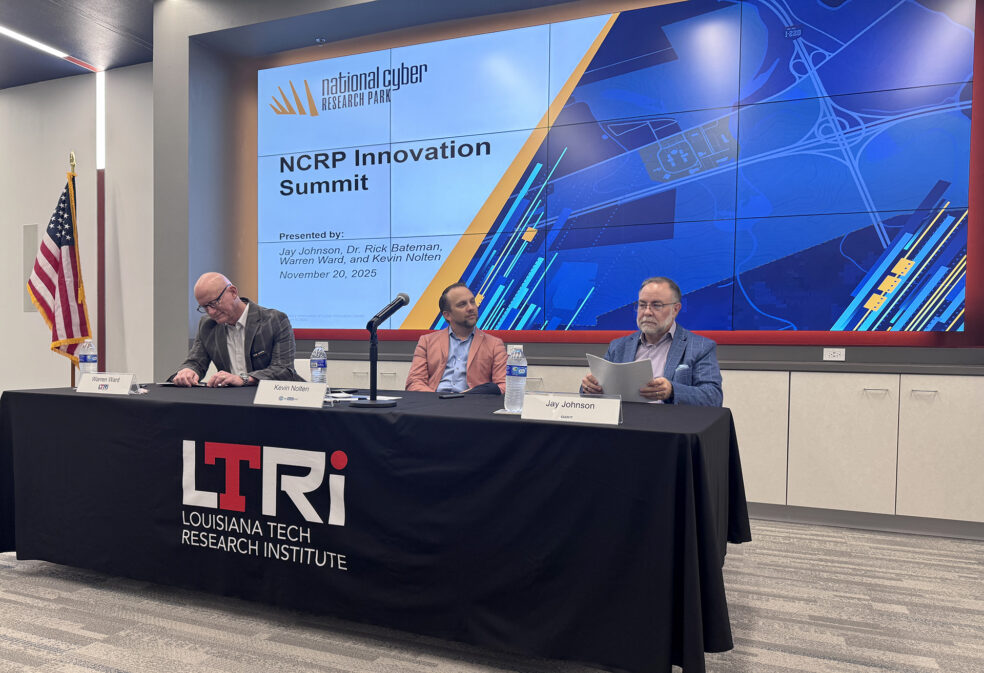
A community forum last month highlighted how the National Cyber Research Park (NCRP) continues to shape the region’s economy and quality of life. Leaders from the Cyber Innovation Center (CIC), General Dynamics Information Technology (GDIT), and the Louisiana Tech Research Institute (LTRI) joined a panel discussion to reflect on the NCRP’s evolution and its growing role in the technology and defense sectors.
CIC President Kevin Nolten, GDIT Vice President of Technology Shared Services Customer Engagement Jay Johnson, and LTRI Executive Director Warren Ward emphasized that close collaboration with their entities and Bossier Parish Community College (BPCC) has been essential for success.
“We all talk, no matter if it’s a crisis or an economic development opportunity,” Nolten said. “With our partners, we’re able to accomplish a lot, as you can see.”
 The original vision for the NCRP was ambitious: transform a cow pasture into a state-of-the-art campus that would attract high-tech employers, create well-paying careers, and elevate the quality of life in northwest Louisiana. Nolten said today’s thriving NCRP is the fulfillment of that 20-year-old plan.
“When we talk about collaboration and innovation taking place, we couldn’t have scripted it any better,” he said. “It’s a natural evolution of a community wanting to make a difference and set itself up for future success.”
Johnson noted that GDIT, one of six business units nationwide, may not manufacture physical products, but its impact is nonetheless significant — more than 2,000 new jobs and more than $267 million in economic impact.
“I don’t build product; I build people,” Johnson said. “The bulk of the GDIT workforce is in Louisiana for a reason: This is a great community with higher-education and community partners.”
LTRI supports senior government leaders through research capacity and specialized education.
Ward highlighted their Global Strike National Security Fellowship Program, which has enrolled 45 students from three universities to address real-world challenges for the Air Force Global Strike Command. Meanwhile, LTRI’s Nuclear Command, Control, and Communications (NC3) continuing-education program has trained more than 3,000 nuclear professionals at Barksdale Air Force Base.
“We are working to build a pathway for Airmen with technical training to earn credentials and become more marketable to industry,” Ward added.
CIC’s CYBER.ORG and STRIKEWERX divisions demonstrate how deeply intertwined the partners’ missions have become. CYBER.ORG provides teachers nationwide with cybersecurity curricula and resources that prepare students for cyber careers. Those students often continue their education at BPCC and later join companies like GDIT.
“CYBER.ORG is growing that pipeline of students for BPCC, who then feed GDIT so Jay can hire them after graduation,” Nolten explained.
 STRIKEWERX leverages technology and rapid-problem-solving methods to help Air Force Global Strike Command identify and work with small businesses and nonprofits at a fraction of traditional costs.
“We can pass those challenges off to LTRI for Warren and his team to help solve, like with the Fellowship and NC3 courses,” Nolten said.
He highlighted several STRIKEWERX success stories: an augmented and virtual-reality air-refueling trainer that reduced required training flights from 13 to six — saving $10 million annually — and a wearable software-defined radio that is expected to save the Air Force $200 million by replacing outdated alerting technology.
Looking ahead, Nolten said collaboration between the NCRP and the broader business community will continue to drive economic growth and enhance quality of life. He pointed to the East Bank District in Bossier City as an example.
“The East Bank District is here because of GDIT,” he said. “GDIT’s young workforce needed somewhere to go and have fun. That contributes back to the community because it’s something everyone gets to enjoy. We want people to see our quality-of-life components.”
The partners are now focused on recruiting more small businesses, extending their model across the region, and strengthening their ties with higher education.
“I want to see my people leave me and start a business here,” Johnson said. “Higher-education partnerships differentiate you as a community. We change curriculum and certificates, connect people to the jobs, and connect students to the employers.”