
A Deep Dive into the National Cyber Research Park: CIC Makes Positive Impact on Bossier
Two decades ago, few people would have imagined that a stretch of farmland in Bossier City would become a national hub for cyber education, defense innovation, and workforce development.
Today, the National Cyber Research Park (NCRP) represents a remarkable transformation that has reshaped the local economy and how Louisiana contributes to the nation’s defense priorities. As the NCRP anchor, the Cyber Innovation Center (CIC) has continued to guide that evolution to meet changing times.
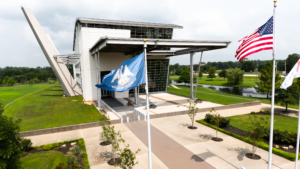 The story begins in 2007, when local leaders launched an ambitious effort to create a technology-driven future for northwest Louisiana. The NCRP was born and the CIC was envisioned as the future headquarters for the U.S. Air Force’s provisional Cyber Command. While that mission ultimately evolved in a different direction, the CIC’s leadership recognized an opportunity that would prove even more impactful in the years ahead.
When the Department of War stood up Air Force Global Strike Command (AFGSC) at nearby Barksdale Air Force Base, the CIC and local leaders quickly adapted their vision. The center’s state-of-the-art facility, strategic location, and growing partnerships positioned it to support this new major command.
“Working alongside city, parish, and state officials, the CIC refined its mission around supporting national security, technology innovation, and workforce development,” said Kevin Nolten, CIC president. “The result is more than a building. It’s an ecosystem that connects government, industry, academia, and the military to accelerate innovation in defense and workforce education.”
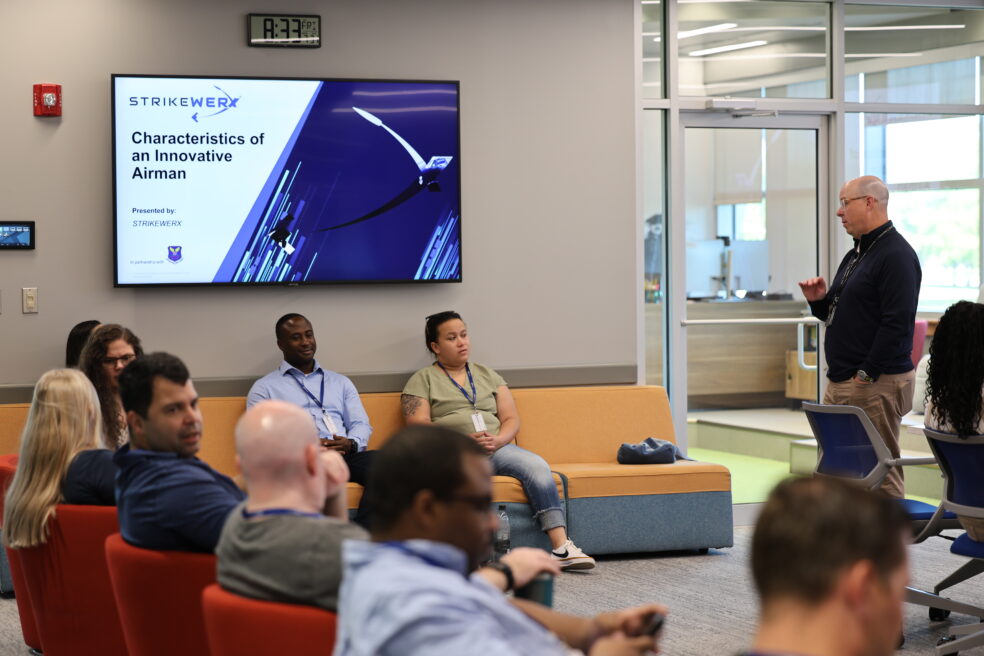
 That partnership with AFGSC led to a collaborative model for solving complex defense challenges through rapid prototyping, market research, and data analytics. The result was STRIKEWERX, AFGSC’s innovation hub that matches emerging technologies with Air Force needs.
Today, STRIKEWERX has delivered dozens of innovative solutions and is projected to have saved the U.S. Air Force nearly $300 million.
“Our goal is to support the warfighter and ensure that AFGSC’s lethality and agility remain at the top of the force,” Nolten said. “How that translates to a local level is that our success in STRIKEWERX has positioned Bossier City as a contributor to national defense innovation rather than only being home to Barksdale AFB.”
While these moves were being made, CIC leaders recognized another equally important challenge in the lack of qualified cybersecurity professionals entering the workforce.
To help address that gap, the CIC partnered with the Department of Homeland Security to establish CYBER.ORG. The initiative was built around educating future professionals starting at K-12, no matter their proximity to Bossier City.
“What began as a regional pilot program has since grown into one of the nation’s leading K-12 cybersecurity education initiatives,” Nolten highlighted. “Through curriculum development, teacher training, and classroom resources, CYBER.ORG has reached more than 5 million students and 45,000 educators across all 50 states, inspiring a new generation to pursue careers in cyber and technology fields.”
As these initiatives expanded, so did the influence of the NCRP. The 3,000-acre development attracted major defense contractors, technology firms, and research organizations seeking proximity to Barksdale AFB and the ecosystem cultivated by the CIC. Together, these organizations have helped transform Northwest Louisiana into a destination for technology investment and high-skilled employment.
 The economic impact has been substantial. According to 2025 statistics, the NCRP supports more than 2,600 jobs, has generated approximately $1.5 billion in household earnings, $1.45 billion in sales activity, and $70 million in tax revenue since its inception.
“Those numbers tell an important story, but they do not tell the whole story,” Nolten cautioned. “Behind every statistic are students who discovered new career paths, entrepreneurs who found new opportunities, and families who built a future here. That might be the CIC’s greatest achievement.”
Having grown from a vision for farmland to today, the CIC has become something that even its founders may not have imagined. It is proof that communities can reinvent themselves.
“Our story is one of people who chose to make a bold investment in their community’s future and rode all the waves to reshape not only our corner of the state, but way beyond,” Nolten concluded.
Discover more from Be Bossier
Subscribe to get the latest posts sent to your email.